>Corresponding Author : Katheryn Goldman
>Article Type : Research Article
>Volume : 3 | Issue : 1
>Received Date : 15 May, 2026
>Accepted Date : 25 May, 2026
>Published Date : 09 June, 2026
>DOI : https://doi.org/10.54289/JPPC2600102
>Citation : Johnson A, Murarka M, and Goldman K. (2026) Pediatricians' Perspectives on Barriers to Pediatric Oral Health Care. J Pediatr Prim Care 3(1): doi https://doi.org/10.54289/JPPC2600102
>Copyright : © 2026 Johnson A, et al. This is an open-access article distributed under the terms of the Creative Commons Attribution License, which permits unrestricted use, distribution, and reproduction in any medium, provided the original author and source are credited.
Research Article | Open Access | Full Text
Division Chief- Dentistry, Pediatric Residency Program Director, Dental Outreach Program Director, Nemours Children’s Hospital, 1600 Rockland Road, Wilmington, DE
*Corresponding author: Katheryn Goldman, Division Chief- Dentistry, Pediatric Residency Program Director, Dental Outreach Program Director, Nemours Children’s Hospital, 1600 Rockland Road, Wilmington, DE
Abstract
Background: The American Academy of Pediatric Dentistry (AAPD) recommends that all children establish a dental home by age one or at the eruption of the first primary tooth. Pediatricians play a critical role in facilitating early dental care; however, many children do not establish a dental home in a timely manner. While prior research has examined pediatricians’ oral health knowledge and practices, limited literature explores pediatricians’ perspectives on barriers to early dental home establishment and potential strategies to improve access. This qualitative study explores pediatricians’ perceptions of barriers to establishing a dental home in accordance with AAPD guidelines.
Methods: This study used a qualitative analysis design. Semi-structured interviews were conducted with practicing pediatricians at a pediatric children’s hospital representing diverse clinical settings and patient populations. Interviews were audio recorded, transcribed verbatim, and analyzed using qualitative thematic analysis with coding and consensus review. Descriptive frequency counts were used to contextualize thematic prominence. A final codebook was then fabricated that includes themes, supporting codes, descriptions, and representative quotes.
Results: Pediatricians identified multiple, interrelated barriers to early dental referral. Limited pediatric dental provider capacity, challenges navigating insurance coverage, and fragmented referral workflows were commonly cited as barriers that undermined timely access to care. Participants also noted inconsistent guidance across dental providers and gaps in awareness of AAPD recommendations, as well as family level challenges such as limited understanding of early oral health, competing priorities, and logistical constraints. Together, these findings illustrate how structural and practical barriers intersect to delay establishment of an early dental home.
Conclusions: This study demonstrates that barriers to establishing an early dental home arise from the interaction of provider, family, and system level factors rather than isolated failures by pediatricians, families, or dental providers. Pediatricians’ perspectives highlight the need for interventions that address referral infrastructure, professional alignment, and access constraints while supporting care delivery within existing primary care workflows. Pediatrician informed, system level approaches may improve adherence to AAPD recommendations and support timely preventive dental care.
Abbreviations: AAPD: American Academy of Pediatric Dentistry, MDI: Medical–Dental Integration
Introduction
Primary care and pediatric dental care are inextricably linked in the joint goal of preventing early childhood disease and promoting optimal lifelong health outcomes. Early childhood caries is a significant chronic disease in childhood and is preventable, especially with early oral health intervention [1]. For this reason, the American Academy of Pediatric Dentistry (AAPD) recommends that all children have their first dental visit by age one or at the eruption of the first primary tooth [1,2]. Pediatricians are important interdisciplinary partners in ensuring that a family obtains dental care for children at a young age. While existing literature has examined pediatricians’ knowledge, attitudes, and general practices regarding children’s oral health, there is a paucity of literature focused specifically on pediatricians’ perceptions of barriers to establishing a dental home per AAPD recommendations. Of the existing literature on this subject, there is a body of literature that suggests that pediatricians have limited training and knowledge surrounding oral health. For example, one study found that pediatricians often lack knowledge regarding the recommended age for the first dental visit, the early signs of dental caries, and fluoride use [3]. Similarly, other research reported that although many pediatricians believe they should examine teeth and educate parents about oral health, only about half do so in practice, largely due to a lack of training and confidence [4].
Beyond knowledge and training gaps, existing literature also suggests structural and system level barriers that may impede pediatricians’ efforts to support early dental care. One survey found that pediatricians identified a limited number of dentists accepting Medicaid as a moderate-to-severe barrier to dental access for young children, particularly those aged 0–3 years [4]. Similarly, one study found that pediatricians reported time constraints during appointments as a significant barrier to addressing patient’s dental needs [5]. Other research further identified broader system level challenges, including poor coordination between health sectors and unclear responsibility for oral health, as contributors to delays in early dental referrals [6]. However, these studies do not examine pediatricians’ in-depth perspectives on these barriers or explore strategies to support families in establishing an early dental home.
As pediatricians are often the first point of medical contact for children under the age of one, their perspectives are critical to improving care pathways that support early oral health. This study aims to explore pediatricians’ perceptions of the barriers that prevent families from establishing a dental home in accordance with AAPD guidelines. By identifying challenges related to provider knowledge, patient level factors, and systemic issues, this research seeks to highlight opportunities for targeted interventions. These findings may inform training efforts, enhance care coordination, and support the prevention of early childhood caries through timely intervention.
Research Methodology
Study Design
This study used a qualitative analysis design to explore pediatricians’ perceptions of barriers to establishing a dental home by age one or at eruption of the first primary tooth, in accordance with AAPD guidelines. A qualitative approach was selected to allow for in-depth exploration of provider perspectives related to early dental referral practices.
Participants and Setting
Pediatricians employed at a children’s hospital were invited to participate in this study through direct outreach. Pediatricians represented a range of years in practice (early-career, mid-career, and long-time providers) and practice settings, including hospital based inpatient and outpatient clinics, academic medical centers, private practices, and community based outpatient settings. Participants served diverse patient populations with respect to age range, insurance coverage, language, socioeconomic background, and geographic context.
Data Collection
Data was collected through individual semi-structured interviews conducted with practicing pediatricians. Those who expressed interest coordinated with the researcher to schedule a semi-structured interview conducted via Microsoft Teams. Each interview followed a standardized script designed to ensure consistency while allowing participants to elaborate on their experiences and perspectives. The script began with obtaining verbal consent for participation and transcription, emphasizing confidentiality and voluntary involvement. Participants were reminded that no identifying information would be collected and that they could discontinue at any time.
The interview included six open-ended questions:
1. How long have you been practicing pediatrics and in what type of setting? (private practice, hospital-based, community clinic, etc.)
2. Can you describe the patient population you primarily serve? (age ranges, insurance coverage such as Medicaid/private, cultural or linguistic diversity, urban/rural setting, etc.)
3. From your perspective, what factors most often prevent children from establishing a dental home by age one or at the eruption of the first primary tooth? (family factors, provider factors, and system-level factors)
4. Are there any challenges you personally face when trying to refer patients for early dental care? (referral networks, availability of pediatric dentists, parental receptiveness, time constraints, etc.)
5. What changes or supports do you believe would make it easier for your patients to establish a dental home by age one or the eruption of the first primary tooth? (this could include anything in your practice, your workflow, or the healthcare system)
6. In your opinion, what would make the process of referring patients to a dentist at an early age smoother or more successful?
Interviews were audio recorded and transcribed verbatim. All transcripts were reviewed for accuracy and de identified prior to analysis to maintain participant confidentiality.
Qualitative Coding and Theme Development
Qualitative data analysis was conducted using Microsoft Word. An initial cycle of open coding was performed by reviewing transcripts line-by-line and assigning descriptive codes to meaningful units of text.
Following initial coding, codes were reviewed and grouped using axial coding to identify relationships and recurring patterns. Codes were then consolidated into broader categories and themes corresponding to the interview questions. A theme codebook was created that included theme names, supporting codes and representative quotes from the transcripts. The full codebook is provided in Appedix A.
To enhance rigor and reduce potential researcher bias, emerging themes and code groupings were reviewed and discussed with two additional reviewers until consensus was achieved.
Quantitative Descriptive Analysis
Following theme development, a quantitative descriptive analysis was conducted to provide information regarding the prominence of themes and supporting codes across interviews. The frequency with which the themes and supporting codes appeared within transcripts was recorded. Since participants often described multiple overlapping barriers and supports, codes were not mutually exclusive. Frequency counts were used to illustrate commonly discussed topics rather than to indicate prevalence or relative importance.
Ethical Considerations
This study involved minimal risk to participants. Participation was voluntary, and informed consent was obtained prior to each interview. All data was de-identified during transcription and analysis to protect participant confidentiality.
Results
Participant Characteristics
Eleven pediatricians participated in the study, representing a range of clinical experience and practice settings. Participants included early-career (0–10 years), mid-career (10–20 years), and long-time providers (20+ years), with the majority having more than ten years of pediatric practice experience. Practice settings include hospital-based inpatient and outpatient clinics, academic medical centers, private practices, and community-based outpatient settings.
All participants provided care to children from birth through young adulthood (0–20/21 years), with several reporting care of medically complex pediatric and young adult populations. Most pediatricians described serving patients insured through Medicaid, including both instate and out-of-state plans, as well as patients with private or commercial insurance. Uninsured and self-pay patients, including those receiving institutionally funded care, were also represented. Participants reported serving linguistically and culturally diverse populations, including non-English–speaking families, refugees, undocumented patients, and recent immigrants. Patient populations spanned a range of socioeconomic backgrounds and geographic contexts, including urban, suburban, and rural communities.
Barriers, Referral Challenges, and Improvement Opportunities
Analysis of interview data revealed several recurring themes related to barriers to establishing a dental home per AAPD recommendations, challenges in early dental referral, and potential supports to improve access. Themes emerged across multiple interview question.
Theme 1: Limited Pediatric Dental Provider Availability and Capacity
Limited access to pediatric dental providers emerged as one of the most frequently reported barriers to establishing a dental home. Participants described a general shortage of pediatric dental providers, particularly in rural areas. In these settings, pediatric dental care is often delivered by general dentists, who may limit the age at which they accept pediatric patients:
“Dental care in this area is provided primarily by family dentists. The practices that [redacted] serves typically do not accept new patients until at least three years of age, and some even stretch it out to five years of age.”
Even in communities where pediatric dental practices are geographically available, pediatricians emphasized significant challenges related to appointment availability. Long wait times were commonly cited as a substantial barrier to timely access to care:
“Sometimes the wait list is six to twelve months out.”
“You know where we live, there is a lot of dentistry, but getting in is very difficult. Even if they have openings, it’s usually a very long wait time.”
“We have a whole list of dentists that we refer to across the county. But often families tell us they’ve called and been told there are no openings. I usually tell them to put themselves on the waitlist, even though, unfortunately, it does mean waiting.”
In addition, participants mentioned that many pediatric dentists in their area no longer accept Medicaid, and some practices have even discontinued participation in certain private dental insurance plans:
“Not all of the dental practices will participate with Medicaid so insurance is an issue as well that limits access.”
“Many pediatric dental providers do not accept Medicaid, and families have reported that some practices have stopped accepting certain private dental insurance plans.”
“A lot of pediatric dentists in the area don’t accept Medicaid anymore.”
Finally, participants also noted a lack of dental providers who care for children with special health care needs:
"I also work with a lot of kids who have special needs and there are far and few between of dentists who will take patients who are clinically complex."
“When it comes to complex kids who need sedation, there really aren’t a lot of options, and those make up a large portion of my patients."
Theme 2: Insurance and Financial Barriers
Insurance related challenges were frequently identified as a significant barrier to early dental care. Pediatricians reported that many families lack dental insurance for their children, noting that dental coverage is often separate from medical insurance. When dental benefits are not included, families were described as being less likely to purse early dental care, especially when children are asymptomatic:
“In the commercial insurance population, if their insurance does not include dental care, it’s very difficult to get them to go to the dentist, especially if there is nothing wrong with the child’s teeth.”
Cost was also described as a barrier to early care. Pediatricians reported that out-of-pocket expenses were often financially burdensome for families. Since many dental providers have stopped taking insurance, whether that be public or private, families with Medicaid and private-insurance and those without dental coverage are all affected:
“The cost of a dental visit is a big barrier for most of our Medicaid patients. If the dentist does not participate, they just cannot afford to pay it, so they will wait until three or five years of age to see their family dentist.”
“Families who do not have Medicaid or private dental insurance, a lot of them do not want to pay out of pocket.”
“You know, a lot of parent’s won’t take their kids if they don’t have dental insurance.”
Finally, participants also described dental insurance enrollment gaps as a challenge to early access. Pediatricians noted that families may not enroll infants in dental insurance because it is not at the top of mind, especially since their child does not have teeth yet. When dental care is later sought, families may be unable to add coverage until the next enrollment period, resulting in delays:
“For children with commercial insurance, families usually add dependents when they select benefits, which often happens only once a year. Dental coverage is separate from medical insurance, and if families do not add it at that time, often because the child is a baby and does not yet have teeth, they may have no dental coverage when the child does develop teeth. In those cases, families may have to wait another year to enroll or pay out of pocket.”
Theme 3: Inconsistent Age Criteria and Guideline Awareness Among Providers
Inconsistent age criteria for the first dental visit and limited awareness of current AAPD guidelines emerged as barriers to early dental referral. Pediatricians reported receiving conflicting guidance from dental providers, with families often being advised to delay dental visits past the age of one:
“I have spoken to pediatric dentists, and I was always taught that an initial visit between ages two and three is acceptable, as long as there are no issues, because it's difficult to get kids in sooner. I have had some parents say that their dentist will not see their child until age three or older, so I typically recommend a first visit between ages two and three.”
“Most dentists will tell you they really cannot do a lot before the age of three.”
“There are not a lot of pediatric dentists that will take an infant or young toddler for the first visit.”
“I bet a lot of those providers, I’m not even sure they really accept kids by age one. I hear from other parents who say, ‘Yeah, we called, but they told us there was no need to make an appointment until age three or two and a half.’ So parents are hearing these conflicting messages and don’t really know what to think.”
Some pediatricians also acknowledged their own uncertainty regarding updated AAPD recommendations:
“I think in terms of providers, there is not widespread understanding of how early children should see a dentist.”
“I will be honest, I was telling families to start going to the dentist at one year old. I did not realize that they could go less than a year.”
One provider mentioned that she did not agree with AAPD recommendations;
“Personally speaking, I think age 1 is a little early.”
Theme 4: Parental Awareness, Beliefs, and Practical Constraints
Parental awareness, beliefs, and practical constraints emerged as barriers to establishing a dental home by AAPD recommendations. Pediatricians reported that many families lack awareness of when children should begin seeing a dentist, often reflecting limited education about early oral health:
“I think the education around when people should start going to the dentist is limited. I even have some patients that are three or four and I’ll ask them if they’re brushing and they’ll say no, not yet. Should we?”
“Parents are often unaware that they should even think about dental care that early, because for the longest time it was age three...”
Participants also described parental time constrains and forgetfulness as challenges to follow-through on early dental referrals:
“A lot has to do with time constraints from parents, and sometimes they honestly just forget.”
“Sometimes families just forget that it’s important and need a reminder.”
Transportation barriers were also reported, particularly when pediatric dental services required long travel distances or time away from work:
“A lot of families have transportation issues or difficulty getting out of work to take their child to the dentist.”
“Most of our pediatric dental care is 40 to 50 minutes away, with the exception of this one site. So, transportation becomes an issue.”
Finally, pediatricians described parental preference for shared dental providers across siblings as contributing to delayed care, particularly when family dentists advised waiting until later ages:
“Families often go to their older children’s dentist and are told to wait until the younger child is two or three.” “If their other kids are seen at a different office, it doesn’t make sense for parents to take this child somewhere else.”
Theme 5: Fragmented Referral Workflow and System Infrastructure
Fragmented referral workflows and limitations on system infrastructure were identified as barriers to establishing a dental home per AAPD recommendations. Pediatricians described competing priorities during early well-child visits, noting that dental referrals were often deprioritized due to time constraints and the volume of anticipatory required during infancy:
“There is so much to talk about at these visits. Adding another thing in for a toothless child is not at the top of my priority list, and the parents aren’t thinking about it either. So I mean, I think getting every kid to the dentist by the age of one is a tough hill to climb”
“I usually start talking about establishing a dental home between 12 and 18 months. Before age one, it tends to be lower on the priority list.”
Participants also highlighted challenges related to the lack of centralized scheduling or referral system for dental care, unlike other specialty referrals.
“If I refer to ENT, I can click consult and it goes to a central scheduling desk. But for dental care, we do not have a scheduling desk, so it is not seamless.”
In addition, pediatricians reported limited access to up-to-date information about dental providers, including which practices accept specific insurance plans and are comfortable treating medically complex patients.
“Honestly, for me, having a more updated referral list would be very beneficial."
“We have a list of dentists that should accept Medicaid that we’ve had for several years. I’m not sure all of them really do, and I wish I had an updated list.”
“It would be helpful to know which dentists are most comfortable seeing complex patients.”
Discussion
Overall, much of the pediatricians’ feedback aligns with existing literature on barriers to pediatric dental care for young children. These pediatric primary care providers also offered valuable insights into interventions that could help mitigate these barriers. Intervention strategies originating from the referral source are particularly important because they are tailored to pediatricians’ existing workflows and clinical processes. The interviewed providers offered practical suggestions related to parental education, referral guidance, and financial barriers, which are reviewed in the following section.
Improved Parental and Provider Education and Consistent Guidance
Participants emphasized the importance of earlier and more consistent parental education regarding oral health and the recommended timing of the first dental visit. Pediatricians noted that anticipatory guidance beginning as early as the six-month well child visit, along with repeated reinforcement over time, could improve parental understanding and follow-through. Suggested strategies included parental reminders, printed handouts, posters in clinic spaces, and highlighting dental recommendations in after visit summaries, particularly when time constraints limited in-visit counseling:
“Families probably just need more, you know, reminders”
“I think education would be a big factor. Even just having a poster in our office that says to start brushing when the teeth erupt and to go to the dentist at one year old would help.”
“Start educating families about dentistry at the six-month visit, because a lot of what we do then is talk about what will be happening over the next several months and what they need to be aware of.”
In addition to parental education, pediatricians identified the need for provider-focused communication supports, including standardized talking points to use during anticipatory guidance:
“It would be helpful to have some talking points, because I often hear families say their child is too young, similar to when I refer a child to speech therapy and parents say, ‘They’re only one, they don’t need that yet.’ I can explain what I know, but I’m not a dentist. Having clear reasons why early dental visits matter, the benefits and the risks, would really help with family buy-in.”
“Typically, we’re not talking about seeing a dentist before age one. We focus more on oral care and brushing teeth. But if early dental visits are something we should be emphasizing more, then it would be helpful to have guidance for pediatricians on what language to use and to update our after-visit instructions to reflect that.”
Lastly, participants emphasized the importance of consistent adherence to AAPD recommendations across dental providers as a way to improve access to early dental care:
“Universal adoption of the AAPD guidelines, and consistent adherence to them, could really help provide pediatric offices with clearer direction and help create more ways to increase access.”
As previously discussed, parental confusion about when to take a child to the dentist may partly stem from differences in interprofessional recommendations. These challenges are further compounded by the limited availability of pediatric dentists, which often leads to children visiting general dentists, who may lack the expertise or willingness to manage dental disease in very young children. For example, a study of general dentists in North Carolina found that although many believed that one-year-old children at high risk for early childhood caries, including those with existing disease, should be referred to a dentist, fewer than half would accept such a patient referred by a physician into their practices [7]. The present study also supports prior findings that families of young children referred within the community are frequently told that the child is too young to receive dental care [7]. Lastly, the research reported that nearly two-thirds of general dentists believed low-risk children should not be referred to a dental provider until three years of age, even though many indicated they would be willing to accept the child into their practice by age one [7].
This conflicting guidance can be confusing for pediatricians and families, as it directly contradicts the [2] recommendation to establish a dental home by twelve months of age or at the eruption of the first primary tooth. Although the current study was conducted more than ten years later, interprofessional recommendation gaps still exist within the field of dentistry. Therefore, in addition to parent level educational support, more can be completed on a dental organizational level to ensure that interprofessional dental bodies are all aligned with recommendations and ensure that dental educational programs across specialties are educating non-pediatric dental providers using AAPD recommendations.
Enhanced Referral Information and Centralized Dental Resource Systems
Pediatricians consistently described challenges navigating dental referral systems, emphasizing the need for centralized, up-to-date dental resource information. Participants explained that limited access to clear referral guidance made it difficult to efficiently connect families with appropriate dental care. These findings align with existing literature suggesting that the fragmented structure of medicine and dentistry complicates referral pathways and undermines care coordination. One review emphasizes the absence of integrated communication mechanisms, such as shared electronic records or cross-institutional referral systems that allow pediatricians to consult with pediatric dentists once a child is identified [8].
Several pediatricians proposed the creation of a centralized, searchable dental database that would allow pediatricians to quickly identify appropriate dental providers based on insurance participation and patient needs:
“If there was some sort of central database where you could search dental providers and filter by insurance, like you can for psychologists, that would be really helpful.”
Additionally, another provider thought that this list could be further enhanced by a section that noted if a provider was comfortable treating patients with medical complexities:
“It would be helpful to know which dentists are most comfortable seeing complex patients.”
While there are existing recourses through the AAPD and American Board of Pediatric Dentistry that list pediatric dentists, there is limited information in these registries on the specific services that are provided as well as the insurances that the providers accept. While individual insurance companies have lists of participating providers, these lists are not always entirely accurate and require families and providers to be able to navigate these databases.
Lastly, pediatricians also emphasized the usefulness of streamlined scheduling to reduce barriers after a referral is made. Participants suggested that having an on-site scheduler or access to online scheduling could improve follow-through by allowing appointments to be made more easily and in real time:
“If I had someone in my office who could schedule patients on the spot, that would be like heaven. I know it’s not realistic given our current resources.”
"I think if there's the ability to have online scheduling, that would help."
Increased Pediatric Dental Provider Availability and Integrated Dental Services
Participants consistently emphasized the need to expand the availability and clinical capacity of pediatric dental providers as a key strategy to improve access to early dental care as appointment availability seems to lack, especially when it comes to patients with medical complexities and patients who are in need of treatment under sedation:
“Just having more pediatric dental providers available in general would be helpful.”
“Fix the supply of pediatric dentists."
“We just need more dentists.”
In addition to increasing workforce availability, pediatricians highlighted medical-dental co-location as a practical solution to facilitate earlier engagement with dental services. Participants noted that having dental providers physically embedded within primary care setting, even on a limited, part-time basis, could significantly reduce access barriers and improve follow-through:
“I think it would be great if we had pediatric dentistry at the same site where I work on a permanent regular basis. You know, we have subspecialists including optometry and pediatric ophthalmology who are not here every day, but they are at least one day a week. So, I think having pediatric dentistry in the same building, in the same suite, would definitely help increase access.”
“Having co-located dental services would be a huge win… it allows for warm handoffs and makes it easier to take care of kids who might otherwise not show up.”
“Dentistry embedded within the primary care practice for at least straightforward cleanings and evaluations could be really helpful to remove the barrier.”
One participant mentioned that having a pediatric dental office located in the same plaza as their practice was a significant advantage:
“I also think there’s a lack of pediatric dental providers, but our office is literally in the same parking lot as [redacted] Pediatric Dentistry. A lot of our families leave this office, walk right over there, and schedule an appointment in person. They don’t even have to deal with the phone. That’s a real advantage of this office.”
Consistent with these perspectives, prior research shows that limited dental provider availability was frequently identified as a significant barrier to successful referral. One study identified the referral environment as the most influential factor affecting whether medical providers refer children at high risk for caries to dental care [9]. Although providers in that study demonstrated high levels of oral health knowledge and routinely screened for dental disease, most still encountered challenges completing dental referrals due to systemic constraints [9]. Despite being conducted over two decades ago, these findings remain relevant, as similar workforce and access barriers persist within pediatric dentistry today.
To address these challenges, participants in the current study identified medical–dental integration (MDI) as a promising strategy to improve access and streamline referral pathways [9]. In this model, pediatric dental services are delivered within the primary care setting, leveraging existing medical infrastructure to expand care capacity [9]. A review of the literature found that integrated care strategies improve referral processes, documentation practices, operational efficiency, access to preventive services, and appropriate utilization of oral health professionals [10]. By embedding dental care within primary care practices, MDI may help mitigate workforce limitations while supporting earlier continuity of oral health care for young children.
Expanded Insurance Coverage and Financial Supports
Finally, pediatricians identified insurance-related support as a critical component of improving early dental access. From a provider perspective, suggested interventions included offering proactive parental reminders during insurance enrollment and renewal periods to ensure that children are covered by dental insurance before care is needed.
“From our end, we could use insurance enrollment season as an opportunity to remind families to make sure they have applied for their children to have dental insurance. I think that would be helpful.”
In addition to enrollment reminders, pediatricians emphasized the importance of expanded participation of dental providers in insurance programs to improve access. At the same time, participants acknowledged the financial realities of dental practice management, including reimbursement limitations and high overhead costs. As a result, pediatricians stressed the need for system level solutions that balance expanded coverage with sustainable participation for dental providers.
“You can’t make people take insurance they don’t want to take. Dental practices have a lot of overhead, and insurance isn’t always the best payer. But if we could confidently know that children had dental insurance, whether Medicaid or private, and that providers could bill it, that would really help access.”
These perspectives align with existing literature highlighting challenges in current insurance structures. One review argues that policies classifying dental care as elective frequently restrict coverage for preventive services [8]. Limited access to preventive oral health care often results in delayed treatment, allowing disease processes to progress and increasing the likelihood of more invasive and costly interventions.
As a potential system level improvement, pediatricians also suggested greater integration between medical and dental insurance coverage. Participants noted that reducing the separation between medical and dental benefits could simplify navigation for families and facilitate earlier utilization of dental services.
“You know, if dental insurance wasn’t a separate thing and fell under medical coverage, I think that would be helpful.”
Conclusion
This research explored pediatricians’ perspectives on barriers to establishing a dental home by age one or at the eruption of the first primary tooth, in accordance with AAPD recommendations. Findings suggest that delays in early dental care reflect not isolated obstacles, but a convergence of challenges across multiple levels of care. Early dental referral is shaped by structural, professional, and family level factors, including limited pediatric dental provider availability and capacity, insurance and financial constraints, inconsistent age criteria and guideline awareness among dental providers, parental beliefs and practical limitations, and fragmented referral workflows and system infrastructure.
In addition to identifying barriers, participants offered concrete, actionable strategies to support earlier access to dental care. Proposed solutions emphasized interventions that integrate naturally into pediatric primary care and dentistry workflows, including earlier and more consistent parental education, standardized provider messaging grounded in evidence based guidelines, reliable and centralized dental referral resources, improved communication between medical and dental providers, expanded pediatric dental capacity, and enhanced insurance supports.
By centering pediatricians’ firsthand experiences, this study contributes to a better understanding of how early dental referral barriers manifest in everyday clinical practice and identifies opportunities for improvement that originate at the point of referral. These findings highlight the critical role pediatricians play as gatekeepers to early oral health care and reinforce the need for interdisciplinary collaboration between medicine, dentistry, insurers, and health systems.
Future research incorporating the perspectives of families and dental providers may further explain barriers to early dental access and inform the development of coordinated solutions. Additionally, studies evaluating the effectiveness of targeted interventions, such as centralized referral tools, standardized communication supports, insurance integration strategies, and medical–dental integration models, are needed to guide implementation efforts. Addressing these barriers through pediatrician informed, system level interventions have the potential to promote timely preventive dental care, reduce early childhood caries, and mitigate persistent oral health disparities.
Conflict of Interest: The authors have no financial or conflicts of interest to disclose.
References
- American Academy of Pediatric Dentistry. Policy on Early Childhood Caries (ECC): Consequences and Preventive Strategies. The Reference Manual of Pediatric Dentistry, American Academy of Pediatric Dentistry. Orl Heal Policies. 2025;96–100. [Ref.]
- American Academy of Pediatric Dentistry. Policy on the dental home. In The reference manual of pediatric dentistry. American Academy of Pediatric Dentistry. 2025;42–44. [Ref.]
- Dickson-Swift., Virginia., et al. The knowledge and practice of pediatricians in children's oral health: a scoping review. BMC oral health. 2020;20(1):211. [PubMed.]
- Lewis., Charlotte W., et al. Oral health and pediatricians: results of a national survey. Acad Pediatr. 2009;9(6)457-61. [Ref.]
- Goossens., Joline., et al. A Qualitative Study on the Factors Influencing Oral Health Care for Young Children in Belgium. BMC Public Health. 2025;25(1):1018. [PubMed.]
- Alkhtib., Asmaa Othman., et al. Barriers and enablers for oral health promotion programs amongst primary healthcare stakeholders in Qatar - a qualitative investigation. BMC oral health. 2023;23(1):924. [PubMed.]
- Long CM., Quinonez RB., Rozier RG., Kranz AM., & Lee JY. Barriers to pediatricians' adherence to American Academy of Pediatrics oral health referral guidelines: North Carolina general dentists' opinions. Pediatr Dent. 2014;36(4): 309-315. [PubMed.]
- Mistry LN., More S., Agarwal S., Mhaske P., Sharma V., et al. Policy integration of pediatric oral health: aligning medicine and dentistry for child well- being. Front Oral Health. 2026;7. [Ref.]
- Cruz GGD., Rozier RG., & Slade G. (2004). Dental screening and referral of young children by pediatric primary care providers. Pediatrics. 114(5):e642-e652. [PubMed.]
- Christian B., George A., Veginadu P., Villarosa A., Makino Y., et al. Strategies to integrate oral health into primary care: a systematic review. BMJ open. 2023;13(7): e070622. [PubMed.]
Appendex
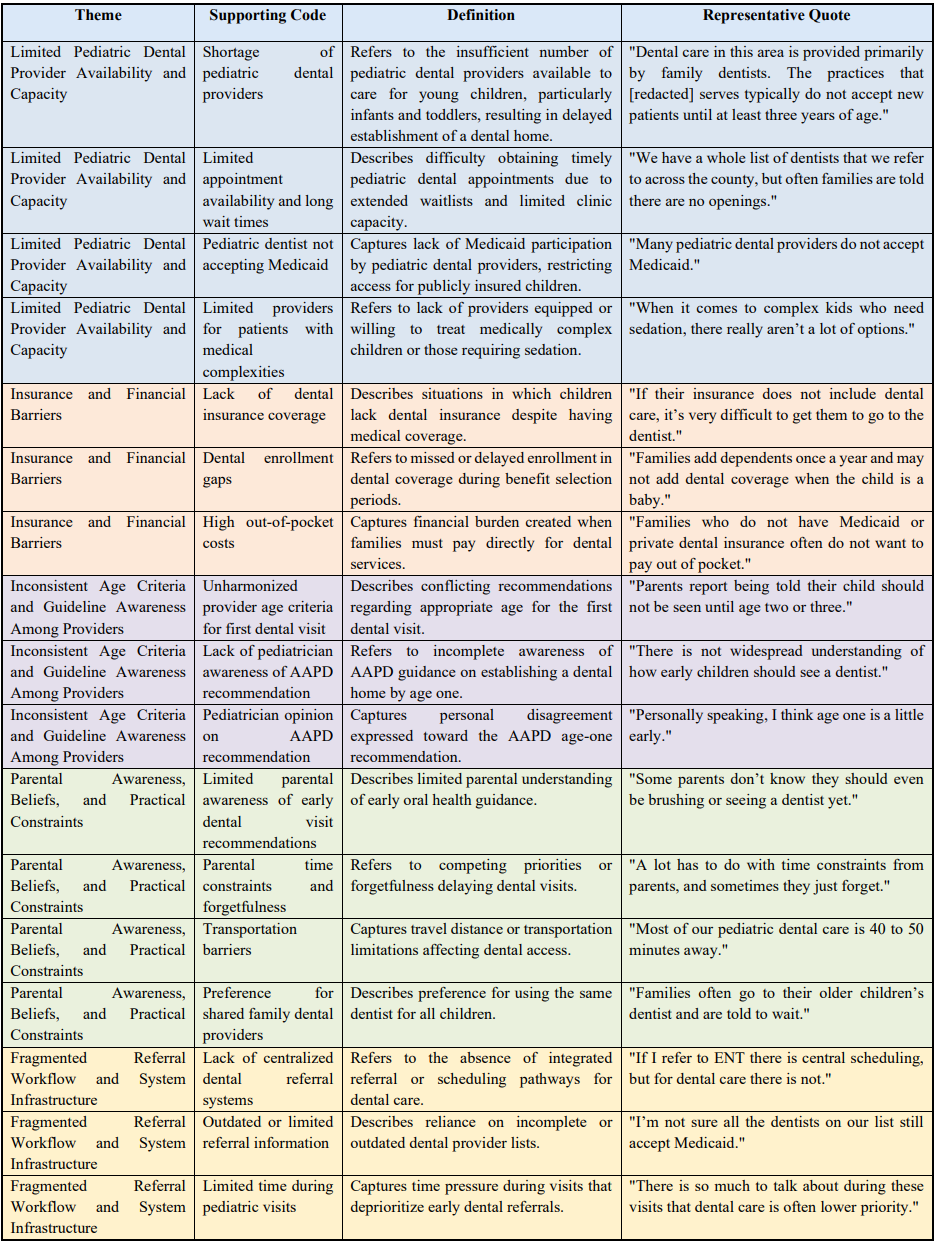
Supplemental Appendix A: Qualitative Codebook