>Corresponding Author : MOUSSAIF J
>Article Type : Case Report
>Volume : 6 | Issue : 3
>Received Date : 20 August 2026
>Accepted Date : 29 August 2026
>Published Date : 1 September 2026
>DOI : https://doi.org/10.54289/JCRMH2600114
>Citation : MOUSSAIF J, BAHLIOUI FZ, ARMEL H, BENCHRIFI Y, WAJIH O, et al. (2026) Bilateral Risk-Reducing Mastectomy with Immediate Prosthetic Reconstruction in a Brca2 Mutation Carrier with Previous Breast Cancer: a Case Report and Review of the Literature. J Case Rep Med Hist 6(3). doi: https://doi.org/10.54289/JCRMH2600114
>Copyright : © 2026 MOUSSAIF J, et al. This is an open-access article distributed under the terms of the Creative Commons Attribution License, which permits unrestricted use, distribution, and reproduction in any medium, provided the original author and source are credited.
Case Report | Open Access | Full Text
1Gynecology-Obstetrics residents, CHU Ibn Rochd, Casablanca, Morocco
2Professors of Gynecology-Obstetrics, Department A, CHU Ibn Rochd, Casablanca, Morocco
*Corresponding author: MOUSSAIF J, Gynecology-Obstetrics residents, CHU Ibn Rochd, Casablanca, Morocco
Abstract
Women carrying a pathogenic variant in the BRCA2 gene have a substantially elevated lifetime risk of breast and ovarian
cancer [1]. Risk-reducing bilateral mastectomy (RRBM) is an established option that can reduce breast-cancer incidence by
more than 90% [2-4]. We report the case of a 34-year-old nulligravid woman with a documented BRCA2 mutation who
had previously undergone breast-conserving surgery, chemotherapy, radiotherapy and hormonal therapy for a left-sided luminal-B invasive carcinoma in 2021. During subsequent high-risk surveillance a stable, small retro-areolar nodule of benign appearance was identified in the contralateral breast. After thorough multidisciplinary counseling the patient elected
bilateral mastectomy with immediate implant-based reconstruction. This case illustrates the decision-making process surrounding secondary risk-reducing surgery in a young BRCA2 carrier with a personal history of breast cancer and underscores the importance of individualized counseling, imaging surveillance and shared decision-making.
Keywords: BRCA2 mutation, Risk-reducing mastectomy, Bilateral mastectomy, Hereditary breast cancer, Case report
Abbreviations: MRI: Magnetic resonance imaging; RRBM: Risk reducing bilateral mastectomy
Case Report
A 34-year-old married, nulligravid woman was referred to our
department for evaluation of surgical risk-reduction options.
She had a documented pathogenic BRCA2 variant and a personal history of left breast cancer diagnosed in 2021.
In 2021 she underwent left tumorectomy. Histopathology revealed an invasive carcinoma of no special type (NOS), Scarff-Bloom-Richardson grade III, luminal-B phenotype, HER2
scored ++, with two metastatic axillary lymph nodes out of
eleven examined (2N+/11N). She subsequently completed adjuvant chemotherapy, radiotherapy and hormonal therapy. Her
mother was under follow-up for breast neoplasia, further supporting the hereditary context.
On clinical examination the patient was in good general condition (blood pressure 120/70 mmHg, heart rate 82 bpm, respiratory rate 16 cycles/min). The left breast showed a well-healed
tumorectomy scar without palpable nodule or mass; the right
breast was free of any palpable abnormality. Axillary and supraclavicular lymph-node basins were clear.
Breast imaging performed as part of high-risk surveillance
demonstrated a small, smooth-contoured retro-areolar enhancement measuring 5 mm in the right breast, classified ACR 3,
while the left breast was ACR 2 (post-therapeutic changes).
Magnetic resonance imaging (MRI) in June 2024 confirmed a
stable, oval, regular-contoured retro-areolar nodule of 6 × 2.5
mm on the right side, judged of benign appearance, together
with discrete thickening of the left nipple-areola complex related to prior treatment. Ultrasound in December 2024 corroborated these findings. The use of MRI in high-risk breast surveillance is consistent with published EUSOMA recommendations [5]. The imaging findings themselves are patient-specific observations.
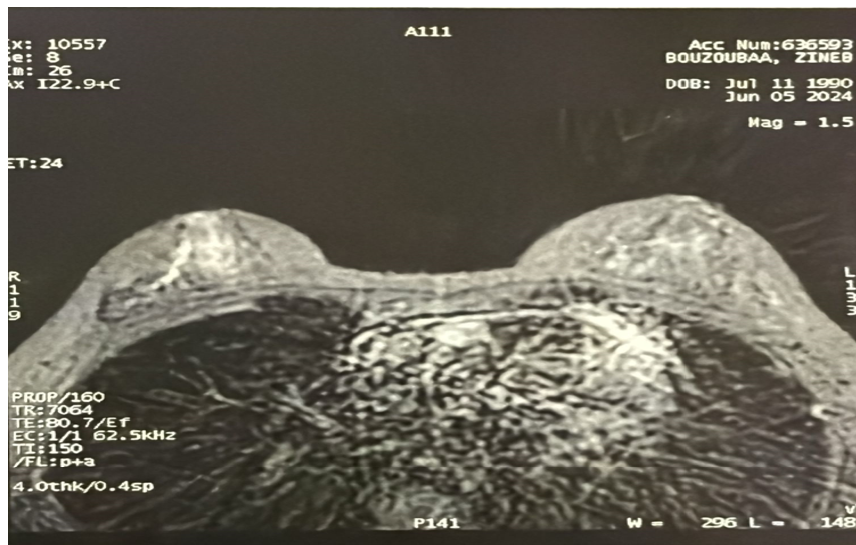
Figure 1. Breast magnetic resonance imaging (MRI) demonstrating the right retro-areolar lesion.
After extensive genetic counseling, psychological support and discussion within a multidisciplinary tumor board, the patient, motivated by her personal and family history and by the residual lifetime risk of contralateral and ipsilateral recurrence, elected to undergo bilateral mastectomy with immediate prosthetic reconstruction. Surgery was performed without major complications. Final histopathology of the resected tissue showed no invasive or in-situ carcinoma
Discussion
Pathogenic variants in BRCA2 confer a lifetime breast-cancer
risk of approximately 45–69 % and an ovarian-cancer risk of
11–17 % [1]. After a first breast-cancer diagnosis the cumulative risk of contralateral breast cancer reaches 20–30 % at
10–15 years, substantially higher than in non-carriers [1]. Consequently, international guidelines (NCCN, ESMO) recommend discussing risk-reducing bilateral mastectomy (or contralateral risk-reducing mastectomy after unilateral disease) as
part of comprehensive counseling [6,7].
In women with a prior personal history of breast cancer who
carry a BRCA2 mutation, secondary risk-reducing surgery
aims to eliminate residual breast tissue that remains at high
risk of a new primary. Several series and systematic reviews
have documented the risk-reducing effect of prophylactic or
contralateral mastectomy in high-risk women [2-4,8,9]. The
procedure reduces the incidence of subsequent breast cancer
by more than 90 % [2], although the magnitude of an overall-
-survival benefit has varied across observational studies
[10-13].
Our patient presented the classic profile of a young BRCA2
carrier: early-onset luminal-B disease, positive family history,
and ongoing high-risk imaging surveillance that identified only a stable, radiologically benign contralateral lesion. The decision for bilateral mastectomy rather than continued surveillance was driven by patient preference after balanced information on residual risk, surgical morbidity, impact on body image and sexuality, and the availability of immediate implant-based reconstruction.
Immediate reconstruction with implants is a widely accepted
option after risk-reducing mastectomy and is associated with
high patient satisfaction when performed by experienced
teams. Nipple-sparing or skin-sparing techniques may further
improve aesthetic outcomes, provided oncologic safety is preserved [14]. In the present case, prosthetic reconstruction was
chosen and yielded a satisfactory result.
Surveillance alternatives (annual MRI ± mammography) remain valid for women who decline surgery [5-7]. Chemoprevention with tamoxifen or aromatase inhibitors may also
be considered, particularly for hormone-receptor-positive disease, although data specific to BRCA2 carriers are still limited
[6,7]. Risk-reducing salpingo-oophorectomy is generally recommended between ages 40 and 45 for BRCA2 carriers once
childbearing is complete [6,7], both for ovarian-cancer risk reduction and for an additional modest reduction in breast-
-cancer risk [15].
This case adds to the growing literature illustrating that, even
after successful treatment of a first breast cancer, a young BRCA2 carrier may reasonably elect bilateral mastectomy with
reconstruction. Shared decision-making, multidisciplinary input and careful preoperative imaging remain essential [5-7].
Conclusion
Risk-reducing bilateral mastectomy with immediate prosthetic reconstruction is a valid and effective option for BRCA2 mutation carriers who have already been treated for breast cancer and who wish to minimize residual risk [2,4,9,10]. Individualized counseling that integrates personal history, family history, imaging findings, reproductive plans and patient values is mandatory [6,7]. Continued long-term follow-up and consideration of risk-reducing salpingo-oophorectomy complete the preventive strategy [7,15].
References
- Kuchenbaecker KB, Hopper JL, Barnes DR, Phillips KA, Mooij TM, Roos-Blom MJ, et al. Risks of breast, ovarian, and contralateral breast cancer for BRCA1 and BRCA2 mutation carriers. JAMA. 2017;317(23):2402-2416. [PubMed.]
- Rebbeck TR, Friebel T, Lynch HT, Neuhausen SL, van 't Veer L, Garber JE, et al. Bilateral prophylactic mastectomy reduces breast cancer risk in BRCA1 and BRCA2 mutation carriers: the PROSE Study Group. J Clin Oncol. 2004;22(6):1055-62. [PubMed.]
- Lostumbo L, Carbine NE, Wallace J. Prophylactic mastectomy for the prevention of breast cancer. Cochrane Database Syst Rev. 2010:CD002748. [PubMed.]
- Carbine NE, Lostumbo L, Wallace J, Ko H. Risk-reducing mastectomy for the prevention of primary breast cancer. Cochrane Database Syst Rev. 2018;4(4):CD002748. [PubMed.]
- Sardanelli F, Boetes C, Borisch B, Decker T, Federico M, Gilbert FJ, et al. Magnetic resonance imaging of the breast: recommendations from the EUSOMA working group. Eur J Cancer. 2010;46(8):1296-316. [PubMed.]
- National Comprehensive Cancer Network. Genetic/Familial High-Risk Assessment: Breast, Ovarian, and Pancreatic. Version 3.2025. [Ref.]
- Paluch-Shimon S, Cardoso F, Sessa C, Balmana J, Cardoso MJ, Gilbert F, et al. Prevention and screening in BRCA mutation carriers and other breast/ovarian hereditary cancer syndromes: ESMO Clinical Practice Guidelines for cancer prevention and screening. Ann Oncol. 2016;27(suppl 5):v103-v110. [PubMed.]
- Hartmann LC, Schaid DJ, Woods JE, Crotty TP, Myers JL, Arnold PG, et al. Efficacy of bilateral prophylactic mastectomy in women with a family history of breast cancer. N Engl J Med. 1999;340(2):77-84. [PubMed.]
- Ludwig KK, Neuner J, Butler A, Geurts JL, Kong AL. Risk reduction and survival benefit of prophylactic surgery in BRCA mutation carriers, a systematic review. Am J Surg. 2016;212(4):660-669. [PubMed.]
- Domchek SM, Friebel TM, Singer CF, et al. Association of risk-reducing surgery in BRCA1 or BRCA2 mutation carriers with cancer risk and mortality. JAMA. 2010; 304(9):967-975. [Ref.]
- Metcalfe K, Gershman S, Ghadirian P, Lynch HT, Snyder C, Tung N, et al. Contralateral mastectomy and survival after breast cancer in carriers of BRCA1 and BRCA2 mutations: retrospective analysis. BMJ. 2014;348:g226. [PubMed.]
- Heemskerk-Gerritsen BA, Rookus MA, Aalfs CM, Ausems MG, Collée JM, Jansen L, et al. Improved overall survival after contralateral risk-reducing mastectomy in BRCA1/2 mutation carriers with a history of unilateral breast cancer: a prospective analysis. Int J Cancer. 2015; 136(3):668-77. [PubMed.]
- Evans DG, Ingham SL, Baildam A, Ross GL, Lalloo F, Buchan I, et al. Contralateral mastectomy improves survival in women with BRCA1/2-associated breast cancer. Breast Cancer Res Treat. 2013;140(1):135-42. [PubMed.]
- Yao K, Liederbach E, Tang R, Lei L, Czechura T, Sisco M, et al. Nipple-sparing mastectomy in BRCA1/2 mutation carriers: an interim analysis and review of the literature. Ann Surg Oncol. 2015;22(2):370-6. [PubMed.]
- Finch AP, Lubinski J, Møller P, Singer CF, Karlan B, Senter L, et al. Impact of oophorectomy on cancer incidence and mortality in women with a BRCA1 or BRCA2 mutation. J Clin Oncol. 2014;32(15):1547-53. [PubMed.]