>Corresponding Author : MOUSSAIF J
>Article Type : Case Report
>Volume : 6 | Issue : 3
>Received Date : 20 August 2026
>Accepted Date : 29 August 2026
>Published Date : 31 August 2026
>DOI : https://doi.org/10.54289/JCRMH2600113
>Citation : MOUSSAIF J, Bahlioui FZ, Bensouda M, Gotni A, Jalal M, et al. (2026) Bilateral Tubo-Ovarian Abscess (Pyo-Ovary) Following Recent Appendectomy in a Virginal Adolescent: a Case Report and Review of the Literature. J Case Rep Med Hist 6(3). doi: https://doi.org/10.54289/JCRMH2600113
>Copyright : © 2026 MOUSSAIF J, et al. This is an open-access article distributed under the terms of the Creative Commons Attribution License, which permits unrestricted use, distribution, and reproduction in any medium, provided the original author and source are credited.
Case Report | Open Access | Full Text
1Gynecology-Obstetrics residents, CHU Ibn Rochd, Casablanca, Morocco
2Professors of Gynecology-Obstetrics, Department A, CHU Ibn Rochd, Casablanca, Morocco
*Corresponding author: MOUSSAIF J, Gynecology-Obstetrics residents, CHU Ibn Rochd, Casablanca, Morocco
Abstract
Tubo-ovarian abscess (TOA) is classically associated with pelvic inflammatory disease in sexually active women. Its occurrence in virginal adolescents is rare and has been described in association with gastrointestinal or genitourinary sources, including complicated appendicitis [1-3]. We report the case of a 16-year-old nulligravid virgin who presented 20 days after
appendectomy with pelvic pain and laboratory evidence of inflammation. Imaging revealed bilateral latero-uterine masses
consistent with tubo-ovarian complexes of infectious origin. Surgical exploration confirmed bilateral pyo-ovaries with a
sealed appendiceal stump, minimal pelvic effusion and false membranes. Bacteriological samples were obtained. This case
highlights the possibility of secondary bilateral tubo-ovarian abscess after recent appendectomy even in the absence of sexual activity, and underlines the need for a high index of suspicion in adolescents with persistent pelvic symptoms after abdominal surgery [2-9].
Keywords: Tubo-ovarian abscess, Pyo-ovary, Appendectomy, Virginal adolescent, Pelvic inflammatory disease, Case report
Abbreviations: TOA: Tubo ovarian abscess
Case Report
A 16-year-old nulligravid (0G/0P) adolescent presented to our
department on postoperative day 20 after an appendectomy
performed via a McBurney incision. She complained of pelvic
pain that had been evolving for one week in a context of fever.
She reported no sexual activity and described herself as virginal.
On admission, vital signs showed blood pressure 100/60
mmHg, heart rate 80 bpm, respiratory rate 20 cycles/min and
temperature 36.7 °C. Conjunctivae were normally colored and
diuresis was conserved. Abdominal examination revealed a
clean surgical scar, a soft abdomen without tenderness or
guarding. Gynecological examination (vaginal and rectal) was
unremarkable; speculum examination was not performed because of the patient’s virginity.
Laboratory investigations demonstrated leukocytosis (16
350/mm³), thrombocytosis (594 000/mm³), hemoglobin 11.53
g/dL, CRP 60 mg/L, urea/creatinine 0.30/5.01 and a negative
serum β-hCG. Urine culture and vaginal swab results were
pending.
Pelvic ultrasound showed two latero-uterine masses measuring 6 cm on the left and 4 cm on the right, with hypo-echoic
and heterogeneous content, without free fluid. Pelvic MRI confirmed bilateral tubo-ovarian complexes (49 × 52 mm on the
right and 60 × 42 mm on the left) suggestive of an infectious
origin, again without peritoneal effusion.
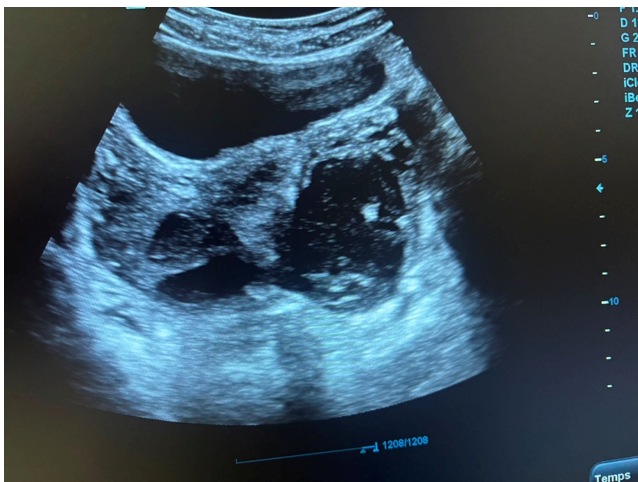
Figure 1. Pelvic ultrasonography demonstrating bilateral complex hypoechoic and heterogeneous adnexal collections consistent with tubo-ovarian abscesses.
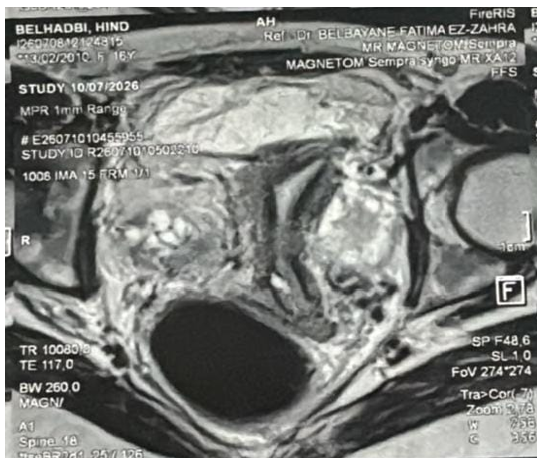
Figure 2. Axial pelvic magnetic resonance imaging demonstrating bilateral complex latero-uterine/adnexal lesions consistent with tubo-ovarian abscesses.
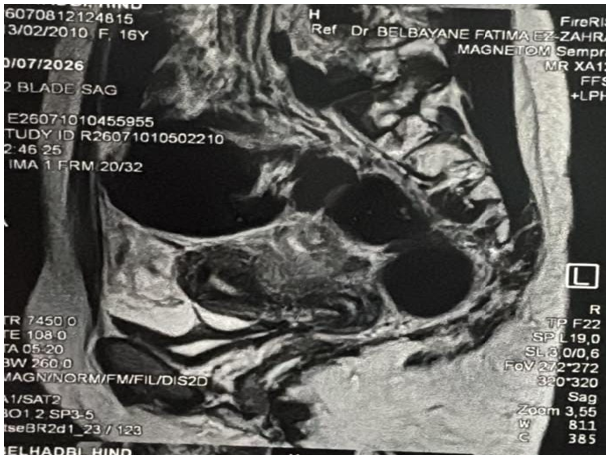
Figure 3. Sagittal pelvic magnetic resonance imaging demonstrating a complex cystic lesion in the pelvic/adnexal region consistent with a tubo-ovarian abscess.
Surgical exploration was undertaken. Intra-operative findings
included a low-abundance pelvic effusion, scattered false
membranes, and bilateral pyo-ovaries. Both fallopian tubes
and the uterus appeared macroscopically normal. The appendiceal stump was sealed and showed no evidence of ongoing leakage. Samples were obtained for cytological and bacteriological analysis.
The patient received appropriate intravenous antibiotic therapy guided by culture results when available. Postoperative recovery was favorable. Fertility-preserving management was
prioritized given the patient’s age and nulliparous status.
Discussion
Tubo-ovarian abscess is an uncommon finding in non-sexually active adolescents. In this population, the pathophysiology
differs from the classic ascending sexually transmitted infection pathway [ 5-7,12,13,15 ]. Contiguous spread from a gastrointestinal source—particularly complicated or perforated appendicitis—has been reported, and bacterial translocation or
pelvic contamination may provide a plausible route to adnexal
infection [ 1-4,13,14 ]. In reported non-sexually active adolescent series, gastrointestinal and genitourinary comorbidities
are frequent, and enteric organisms have been isolated from
abscess specimens [8,9].
Several case reports and small series have documented TOA
occurring days to years after appendectomy for perforated appendicitis in virginal girls [4-7]. Nishida et al. described occurrence five years after appendectomy, while Acker et al. reported bilateral TOA following perforated appendicitis in a non-
-sexually active adolescent [4,6]. Campbell et al. also described TOA after appendectomy complicated by peritonitis
[5]. Our case falls into the early postoperative window (day
20), illustrating that secondary pelvic infection may become
clinically apparent soon after abdominal surgery even when
the appendiceal stump appears sealed at re-exploration
[4-7,10].
Clinical diagnosis is challenging because symptoms may be
nonspecific and abdominal findings may be limited, particularly in adolescents [3,8,9]. Laboratory markers of inflammation
and pelvic imaging are important components of the diagnostic work-up. Ultrasound is commonly used as an initial modality, while MRI or CT may further characterize adnexal disease
when the diagnosis remains uncertain [3,8]. MRI is particularly attractive in adolescents when avoidance of ionizing radiation is desirable [3].
Management aims to eradicate infection while preserving fertility. Broad-spectrum intravenous antibiotics with coverage
appropriate for polymicrobial pelvic infection are a cornerstone of treatment [1,3,11]. Image-guided drainage or surgery
may be required when medical treatment fails, when the abscess is large, or when diagnostic uncertainty persists; larger
TOAs have been associated with a greater likelihood of prolonged hospitalization and intervention [3,11,12]. In the present case, exploratory surgery confirmed the diagnosis, allowed lavage and microbiological sampling, and avoided unnecessary organ removal.
Long-term sequelae of concern include tubal damage, infertility and chronic pelvic pain, which are particularly relevant in
adolescents with future reproductive goals [2,3,11,13]. Available cohort data suggest that appendectomy itself does not necessarily impair fertility, but pelvic infection and adnexal damage may have different implications [14]. Adolescents and
their families should therefore be counseled regarding the potential reproductive consequences and the importance of appropriate gynecological follow-up [2,3,11].
This case reinforces that a recent history of appendectomy
should raise suspicion for secondary tubo-ovarian infection in
an adolescent presenting with pelvic pain and systemic inflammation, regardless of sexual history [2-10].
Conclusion
Bilateral tubo-ovarian abscess can occur shortly after appendectomy in virginal adolescents through a plausible contiguous gastrointestinal route. Early recognition, appropriate imaging, fertility-preserving management and targeted antimicrobial therapy are essential to optimize clinical recovery while limiting potential reproductive morbidity [3-9,11].
References
- Workowski KA, Bachmann LH, Chan PA, Johnston CM, Muzny CA, Park I, et al. Sexually transmitted infections treatment guidelines, 2021. MMWR Recomm Rep. 2021; 70(4):1-187. [PubMed.]
- Squires KC, Merritt DF. Pelvic inflammatory disease in a virginal adolescent: A case report. J Pediatr Adolesc Gynecol. 2014;27(2):e46. [Ref.]
- Garbo G, Cizek S. Tubo-ovarian abscess etiology, presentation, and management in youth and adolescents. Semin Pediatr Surg. 2025;37:151563. [PubMed.]
- Nishida N, Shono T, Shono K, Hashimoto Y, Kawakami K. Late occurrence of the Tubo-Ovarian abscess after appendectomy for perforated appendicitis in a virginal adolescent girl. J Pediatr Adolesc Gynecol. 2022;35(4):509-511. [PubMed.]
- Campbell M, Noor AA, Castaneda M. A case of Tubo-Ovarian abscess in a 15-Year-Old female after appendectomy complicated by peritonitis. Cureus. 2021;13(11) :e20052. [PubMed.]
- Acker S, Bazella C, Ponsky T. Tubo-Ovarian abscess following perforated appendicitis in an adolescent. J Gynecol Surg. 2011;27(1):37-39. [Ref.]
- Serbanescu L, Badiu D, Popescu S, Busu D, Costea A. The management of tubo-ovarian abscesses associated with appendicitis. JMMS. 2021;8(2):280-285. [Ref.]
- Hakim J, Childress KJ, Hernandez AM, Bercaw-Pratt JL. Tubo-Ovarian abscesses in nonsexually active adolescent females: A large case series. J Adolesc Health. 2019;65(2) :303-305. [PubMed.]
- Fei YF, Lawrence AE, McCracken KA. Tubo-Ovarian abscess in Non-Sexually active adolescent girls: A case series and literature review. J Pediatr Adolesc Gynecol. 2021;34(3):328-333. [PubMed.]
- Verta S, Brambs CE, Christmann C. Large douglas abscess with distinctive bilateral salpingitis in a young virginal woman 6 months following small bowel perforation at the level of the jejunojejunostomy after Roux-en-Y gastric bypass: A case report. Int J Womens Health. 2024;16 :2343-2354. [PubMed.]
- Granberg S, Gjelland K, Ekerhovd E. The management of pelvic abscess. Best Pract & Res Clin Obstet & Gynaecol. 2009;23(5):667-678. [Ref.]
- Dewitt J, Reining A, Allsworth JE, Peipert JF. Tuboovarian abscesses: is size associated with duration of hospitalization & complications?. Obstet Gynecol Int. 2010; 2010:847041. [PubMed.]
- Rasmussen T, Fonnes S, Rosenberg J. Long-Term complications of appendectomy: A systematic review. Scand J Surg. 2018;107(3):189-196. [PubMed.]
- Andersson R, Lambe M, Bergström R. Fertility patterns after appendicectomy: historical cohort study. BMJ. 1999; 318(7189):963-7. [PubMed.]
- Goodwin K, Fleming N, Dumont T. Tubo-ovarian abscess in virginal adolescent females: A case report and review of the literature. J Pediatr Adolesc Gynecol. 2013;26(4):e99- e102. [Ref.]