>Corresponding Author : Douha El Karoini
>Article Type : Case Report
>Volume : 5 | Issue : 12
>Received Date : 12 Dec, 2025
>Accepted Date : 22 Dec, 2025
>Published Date : 26 Dec, 2025
>DOI : https://doi.org/10.54289/JCRMH2500162
>Citation : El karoini D, Sakim M, Lamti H, Assal A, Gotni A, et al. (2025) Lethal Thanatophoric Dwarfism: A Case Report. J Case Rep Med Hist 5(12): doi https://doi.org/10.54289/JCRMH2500162
>Copyright : © 2025 El Karoini D, et al. This is an open-access article distributed under the terms of the Creative Commons Attribution License, which permits unrestricted use, distribution, and reproduction in any medium, provided the original author and source are credited.
Case Report | Open Access | Full Text
1Resident Physician, Department of Gynecology and Obstetrics at the Ibn Rochd University Hospital, Casablanca, Morocco
2Professor in the Department of Gynecology and Obstetrics at the Ibn Rochd University of Hospital in Casablanca Morocco
*Corresponding author: El Karoini Douha Resident Physician, Department of Gynecology and Obstetrics, Ibn Rochd University Hospital, Casablanca, Morocco
Abstract
Thanatophoric dwarfism is a rare and lethal congenital bone dysplasia characterized by a narrow thorax, extreme limb shortening, and severe pulmonary hypoplasia. We report the case of a 41-year-old patient who gave birth to a newborn with these abnormalities.
Keywords: Thanatophoric dwarfism, Skeletal dysplasia, Lethal, Prenatal diagnosis, FGFR3
Introduction
Thanatophoric dwarfism (or thanatophoric dysplasia) is a lethal condition belonging to the group of skeletal dysplasias, linked to a mutation in the FGFR3 gene (Fibroblast Growth Factor Receptor 3). It manifests as a very narrow chest, severe shortening of the long bones, macrocephaly, and often spinal abnormalities. The prognosis is poor, with most newborns dying within the first few hours or days of life due to acute respiratory failure caused by pulmonary hypoplasia.
Observation
Ms. F.H., aged 41, IGIP, was admitted to the maternity ward of Abderrahim El Harouchi University Hospital for delivery of a malformed fetus. The morphological ultrasound performed during the third trimester revealed: ventriculomegaly measuring 10.33 mm, a short spine, a narrow thorax, hypoplastic lungs, and short limbs: short and curved femur, suggesting lethal thanatophoric dwarfism.
The patient gave birth vaginally to a premature female newborn weighing 1050 g at 34 weeks + 6 days of amenorrhea, with an Apgar score of 1/10 at birth. The newborn died at 5 hours of life, with severe respiratory distress.
The newborn's clinical appearance was characteristic of thanatophoric dwarfism: very short limbs, barrel chest, prominent abdomen, and macrocephaly. The diagnosis was confirmed clinically.
An autopsy was not performed at the request of the family.
Discussion
Thanatophoric dwarfism is one of the most severe skeletal dysplasias, with an estimated incidence of 1/20,000 to 1/50,000 live births. It is transmitted in an autosomal dominant pattern, but the majority of cases are due to de novo mutations [1].
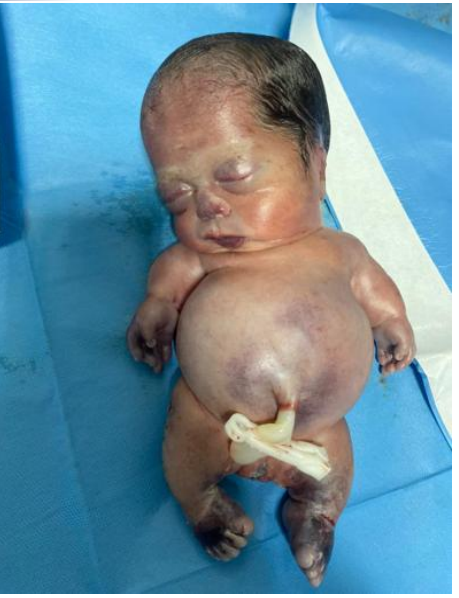
Two types are described: Type I: bucket-handle femurs, without cloverleaf skull; Type II: straight femurs, with characteristic cloverleaf skull [2].
The diagnosis is usually possible from the second trimester onwards by morphological ultrasound, which reveals severe shortening of the long bones, a narrow thorax, and sometimes macrocephaly or ventriculomegaly.
In our case, the ultrasound abnormalities strongly suggested this condition. The association with a polymyomatous uterus may have complicated ultrasound monitoring, but there was no direct etiopathogenic link with the dysplasia [3].
The prognosis is invariably fatal due to major pulmonary hypoplasia. No curative treatment exists to date. Management is essentially palliative and multidisciplinary, focusing on parental support and genetic counselling [4].
Conclusion
Thanatophoric dwarfism remains a rare and devastating condition, with prenatal diagnosis based on morphological ultrasound and confirmed by molecular analysis of the FGFR3 gene. Appropriate psychological and genetic support is essential for affected couples, in order to anticipate the risk of recurrence and provide support during the period of perinatal bereavement.
References
- P Maroteaux., et al. Thanatophoric dwarfism Presse Med. 1967;75(49):2519–24. [PubMed.]
- I M Orioli., et al. The birth prevalence rates for the skeletal dysplasias. J Med Genet. 1986;23(4):328– 32. [PubMed.]
- E J Noe., et al. A case of thanatophoric dysplasia type I with an R248C mutation in the FGFR3 gene. Korean J Pediatr. 2010;53(12):1022–5. [PubMed.]
- L E Machado., et al. Thanatophoric dysplasia Ultrasound. Obstet Gynecol. 2001;18(1):85–6. [PubMed.]